Screening
Come to My (Avant-)Garden
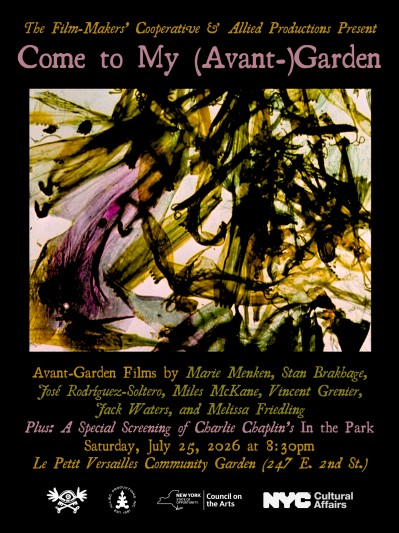
On Saturday, July 25th, at 8:30pm, join us at Le Petit Versailles Community Garden for a program of avant-garden films curated in collaboration with Allied Productions and Zoe Beloff! Spanning 1915 to 2010 and sourced predominantly from the Coop’s collection, these films invoke vernal imagery and public spaces to comment on the distinct yet often intersecting issues of class, immigration, queer identity, HIV/AIDS, and capitalist exploitation.
Gardens have long been a fixture of American avant-garde cinema. Dating back to the 1950s, artists explored and exploded the formal and aesthetic possibilities of flowers, trees, and vernal spaces within the moving image. Perhaps the best-known example is the program opener, Marie Menken’s Glimpse of the Garden (1957): a painterly foray into a public garden that captured the vibrancy of its flora and fauna at an almost microscopic level. Stan Brakhage, a key contemporary of Menken’s, was no stranger to plant life in his work. 1963’s Mothlight is perhaps his best-known film, wherein the artist glued moth wings, grass, and flower petals between two strips of 16mm splicing tape to form a vivid filmic “collage” of natural materials. 1981’s Garden of Earthly Delights — similarly created by pasting montane zone vegetation onto clear film leader as “an homage to (but also argument with) Hieronymous Bosch” — is widely regarded as Brakhage’s companion piece to Mothlight and follows Menken’s film in this program.
While experimental filmmakers such as Menken and Brakhage established a blueprint for “avant-garden” films that favored formal elements rooted in fine art practices (color, texture, movement, materiality) over content or narrative concerns, numerous artists in their wake invoked gardens, public spaces, and natural imagery in their films as means to a political or ideological end. Jerovi (1965) by José Rodríguez-Soltero, made just two years after Brakhage’s Mothlight, recreates the Narcissus myth with a young man “clothed at first in rich brocade, but later nude… photographed lingeringly in a lush garden.” Rodríguez-Soltero was a queer Puerto Rican filmmaker and an integral yet overlooked figure of the 1960s New York underground who worked on political newsreels with the Young Lords and produced films for the United Nations Committee on Decolonization. Filmed four years before the Stonewall riots, Jerovi is notable for its unabashed and sumptuously homoerotic depiction of male nudity within a sylvan context, at a time when such imagery was often deemed “obscene” and could land its makers in legal trouble.
The 1980s and ‘90s saw a resurgence of political consciousness within avant-garde filmmaking due to the global HIV/AIDS epidemic and ongoing inequities exacerbated by a widespread return to conservatism in the United States under the Reagan, and later Bush, administrations. Miles McKane’s Broken Blossoms (1992) is one such example of this trend, described by the filmmaker as “a cinematic metaphor, conceived as part of a compilation of films on AIDS.” Composed of frenetic Super 8mm footage of flowers and trees in a public garden juxtaposed against a resounding instrumental score, the film functions, in the words of McKane, as “an emotional translation of the disease.” Vincent Grenier’s Out in the Garden (1991) similarly situates a man’s HIV/AIDS diagnosis within a garden context, yet in a relatively straightforward (albeit poetic) manner. Lingering shots of silhouettes over soil, flower pots, and long stretches of green grass underscore a poignant voiceover in which the subject slowly comes to terms with his seropositive status. Grenier noted, “The film eschews the usual talking head and focuses on the peculiar occasion for examining anew as brought on by disconnectedness. In the process, questions of identity, one’s sense of reality, the day-to-day and social tyrannies end up implicating the viewer intimately as well.”
Perhaps no other film from this period confronts the inherently political nature of gardens and public spaces as indelibly as Jack Waters’ Berlin/New York (1986). In this Super 8mm piece, originally used as an element in the 1985 dance/theater work A Free Ride, “ruined buildings [and] the remains of post-war Berlin are juxtaposed with similar settings in New York's pre-gentrified mid-1980s Lower East Side.” Of the film, Waters wrote:
Much of the urban rubble shown in the New York footage is now the site of expensive residential and commercial space. While the Berlin footage shows the scars of war, the New York devastation is a result of the late ‘70s fiscal default when land owners torched and scavenged their properties as a way of draining the last possible profit from real estate, after years of deliberate neglect in the impoverished communities that contained them. The film documents such a torching shot during a gallery opening that shocked observers, even though such landlord-initiated arson was a common site. The location was eventually appropriated by the city of New York, which acquired then-warehoused abandoned real estate after a specified period of tax delinquency. It later became a community garden under the auspices of Operation Greenthumb, a community program engendered to make aesthetic, social, and organic use of these lots that became neglected eyesores and centers for drug dealing and violence. This garden contained several casitas artfully constructed by the Latino residents that, despite much duress, still inhabit the area. In 1998, it was bulldozed by the City of New York. Like the Greenthumb gardens, similarly abandoned sites were resurrected by homesteaders and squatters who are routinely evicted from these, their homes, after years of ardent labor and expense. In the film, the inclusion of the Berlin Wall’s Checkpoint Charlie takes past and present transgressions of political force from the civic into a global context. The juxtaposition of the two locations posits the contention that the cycle of abuse that results in decrepit land sites is the result of a malignant principle in capitalism.
Like Waters’ film, Melissa Friedling’s Garden Roll Bounce Parking Lot (2010) explores class, urban space, a community garden, and destruction wrought by capitalism; Friedling also connects these subjects to the filmic medium. Specifically, she documents the recollections of two children in a Bangladeshi family who kept a thriving urban garden in Brooklyn that was later leveled to make room for their father’s livery car. As noted by the filmmaker:
The overhead lattice support for the garden was woven out of a 35mm motion picture film. Bits of the film that were left lying in the street after the garden was cut down for the winter were optically printed. On inspection, it turned out that the found film holding up the garden was the retro Black urban teen movie Roll Bounce (2005), the plot of which hinges around the closing of the protagonists' local roller rink, The Gardens. In addition to their recollections of the found film in the garden, the kids disclose their preoccupations with YouTube, Selena Gomez, and Urdu-language children’s songs. The combination of pop-cultural references along with the “misused” found film is revealing of the profound and creative merging of cultural practices that transforms the contemporary immigrant experience.
Themes of class and the immigrant experience are explored nearly 100 years prior to Friedling’s film (and in completely disparate fashion) in Charlie Chaplin’s 1915 Essanay comedy short In the Park, which concludes this program and offers a witty narrative compliment to the experimental and documentary work featured. Here, Chaplin — an immigrant and a staunch Leftist whose politics led to his exile from the United States in 1952 — chronicles romantic couplings in a public park that are disrupted by a pickpocket, resulting in a stolen handbag, cigarettes, and sausages, and a series of misunderstandings. Slapstick hijinks involving Chaplin’s mischievous and anti-authoritarian “Tramp” persona play out in verdant environs, positing the park as a site of both community and class difference while highlighting the timelessly subversive potential of gardens and public spaces.
Program note by Matt McKinzie.
***
Program:
-
Glimpse of the Garden by Marie Menken (1957), 5 minutes, color, sound, 16mm
-
The Garden of Earthly Delights by Stan Brakhage (1981), 3 minutes, color, silent, 16mm
-
Jerovi by José Rodríguez-Soltero (1965), 12 minutes, color, silent, 16mm
-
Broken Blossoms by Miles McKane (1992), 5 minutes, color, sound, 16mm
-
Out in the Garden by Vincent Grenier (1991), 15 minutes, color, sound, 16mm
-
Berlin/New York by Jack Waters (1986), 20 minutes, color, sound, 16mm
-
Garden Roll Bounce Parking Lot by Melissa Friedling (2010), 5 minutes, color, sound, 16mm
-
In the Park by Charlie Chaplin (1915), 15 minutes, black-and-white, silent, digital
Total Run Time: 80 minutes.
***
All 16mm film prints sourced from the collection of The Film-Makers’ Cooperative. Charlie Chaplin’s In the Park is in the public domain and will be projected digitally.
Public programming and workshops by The Film-Makers’ Cooperative is made possible by the support of the New York State Council on the Arts and the New York City Department of Cultural Affairs.